
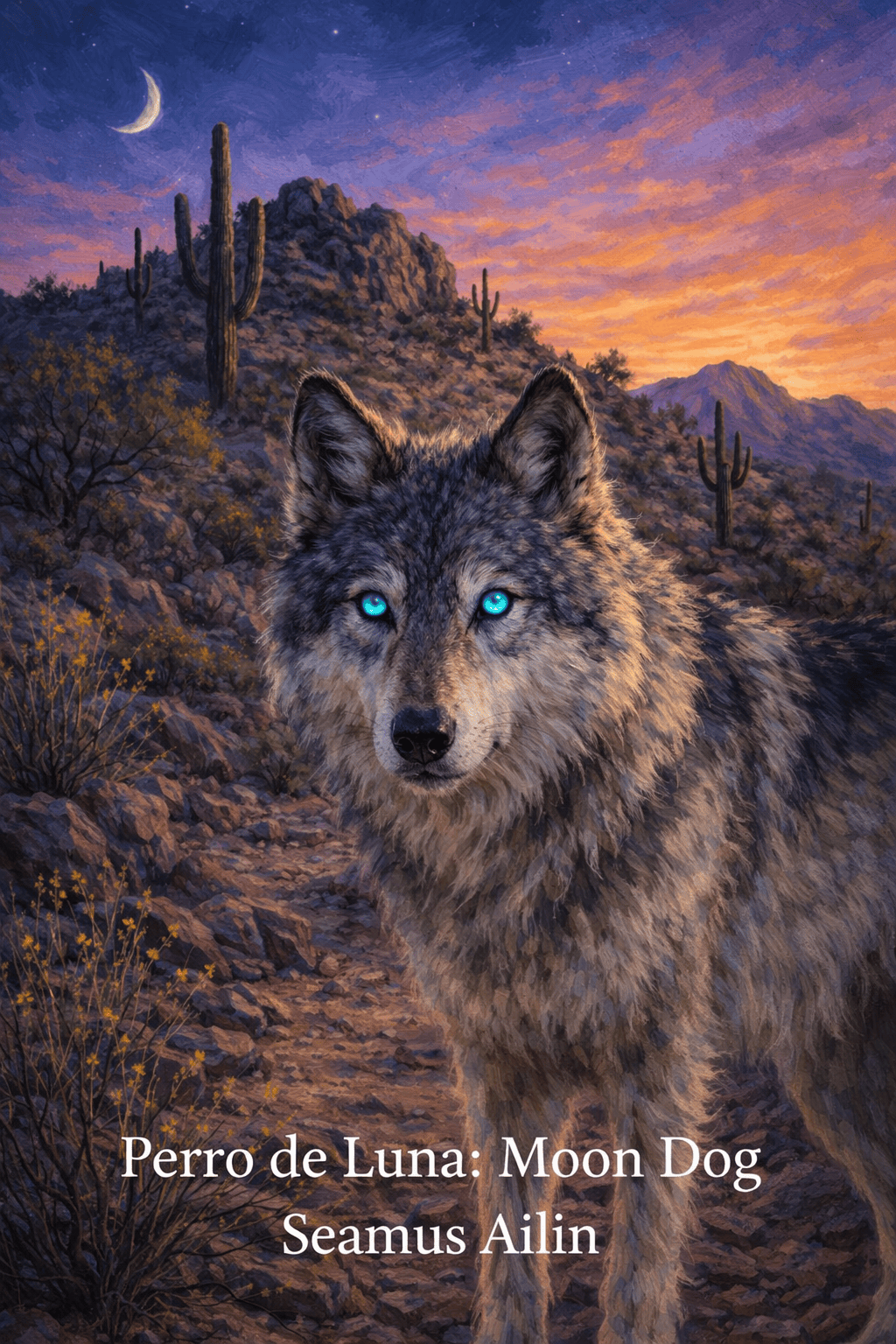
Genre: Middle-Grade Fiction / Adventure
Setting: American Southwest
Perro de Luna: Moon Dog
Not every lost thing is gone. Some are only waiting for the moon to show the way home.
When children become lost beneath the desert moon, old stories say to watch for cactus flowers opening white in the dark. If the flowers bloom, help may be closer than they think.
His name is Perro de Luna — the Moon Dog.
With silver-gray fur, calm turquoise eyes, and a silence older than campfire stories, Perro de Luna appears when a child has truly lost the path. Sometimes that means being lost in the desert. Sometimes it means being lost in fear, grief, change, loneliness, or the belief that no one understands.
Across a series of connected stories, children and families encounter the mysterious Moon Dog at the moments they need him most. Mateo hears the legend as a boy and later carries it forward as a scoutmaster and sheriff. Luke learns that grown-up storms are not his fault. Wyatt searches for belonging in a new desert town. Sophia struggles to make room for a changing family. Melody grieves a beloved old dog. Megan discovers that stories can be true without belonging to every moment.
Gentle, hopeful, and emotionally honest, Perro de Luna: Moon Dog is a desert folktale for thoughtful young readers and families who believe stories can offer courage, comfort, and a little more light for the road home.

How Perro de Luna Found Its Path
Perro de Luna did not begin as a novel.
The original concept was a series of connected stories, each following a different child who encounters the mysterious Moon Dog at a moment when they are lost, whether physically, emotionally, or somewhere in between.
But something happened as the stories were being written. Characters began carrying forward. Events in one story gave greater meaning to another. Mateo, originally part of the framework connecting the tales, became part of a much larger journey.
Eventually came the realization: these were not separate stories connected by a common legend. They were chapters of the same story.
The manuscript was taken apart, re-edited, and rebuilt as a single continuous narrative, allowing characters, relationships, and events to develop from beginning to end.
In the process, Perro de Luna became something different from the book originally imagined.
The story found its own path.